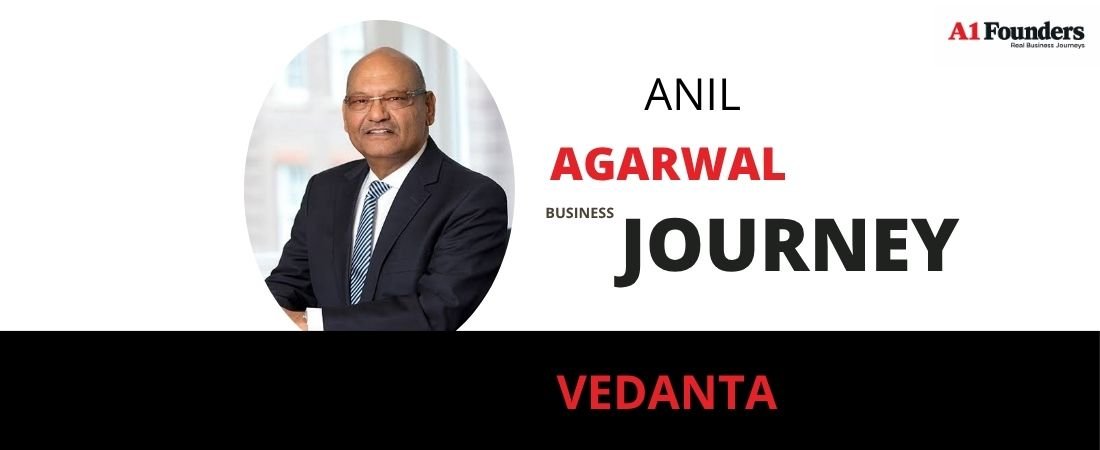
Anil Agarwal is one of the well-known businessmen from India. He is the founder and chairman of Vedanta Group. His business journey is different from many other large business owners because he started with a small trading business and slowly moved into metals, mining, oil, gas, and other natural resources.
Today, Vedanta has businesses in several parts of the world. But the company did not become large overnight. Anil Agarwal spent many years building the business, making acquisitions, and entering new industries.
Early Life of Anil Agarwal
Anil Agarwal was born in Patna, Bihar, in 1954. His father, Dwarka Prasad Agarwal, ran a small business that supplied aluminium conductors.
Anil grew up in a middle-class family. He studied at Miller School in Patna. He did not go to college after school. Instead, he decided to start working and help build a business.
As a young man, he wanted to become financially independent. He also understood that business would require patience and hard work.
His early life was far different from the world of large companies and international investments that he later entered.
Starting His Business
Anil Agarwal started his business journey at a young age. He moved to Mumbai and began trading in metals and other products.
In the early years, he bought and sold scrap materials. This gave him practical experience in buying, selling, negotiating prices, and understanding customers.
These were simple business activities, but they helped him understand how the metal industry worked.
In 1976, he started Sterlite Trading Company. The company was involved in trading metals.
At that time, he did not have a large factory or a huge business network. He had to build relationships with suppliers and customers step by step.
This period became an important part of his business journey.
Moving Into Manufacturing
Trading was only the beginning. Anil Agarwal wanted to move into manufacturing.
His company later entered the cable business. He also started looking at opportunities in copper and other metals.
One of the major steps came in the 1990s when his group acquired a controlling interest in Madras Aluminium Company, also known as MALCO.
This helped the group gain experience in operating industrial businesses.
The company continued to expand its presence in metals and mining. It was no longer only a trading business.
The Growth of Sterlite Industries
Sterlite Industries became an important company in Anil Agarwal’s business journey.
The company focused on metals such as copper and aluminium. It also became involved in mining and related activities.
Sterlite’s copper business became one of its major operations. The company developed large-scale industrial operations and expanded its production capacity.
Anil Agarwal also understood that controlling raw materials could be important for a metals company.
Instead of depending completely on outside suppliers, the group started looking at mining assets and natural resources.
This became an important part of the group’s long-term business strategy.
Entering the Mining Business
Mining became a major part of the Vedanta story.
The group expanded into zinc, lead, silver, iron ore, copper, aluminium, and other natural resources.
One of the biggest developments was the acquisition of a controlling stake in Hindustan Zinc.
The company had been a public sector enterprise. The Indian government started the process of selling part of its ownership in the company in the early 2000s.
Sterlite Industries acquired a controlling stake in Hindustan Zinc in 2002.
This acquisition gave Anil Agarwal’s group a much stronger position in the zinc business.
Hindustan Zinc later became one of the major producers of zinc and lead in the world.
Building Vedanta
The Vedanta name became increasingly important as the group expanded.
Vedanta Resources was established as the group’s main holding company for its natural resources businesses.
The company later listed on the London Stock Exchange in 2003.
This was an important step because it gave the group access to international investors and helped increase its global presence.
Vedanta continued to acquire and develop businesses in metals and mining.
The group also expanded into oil and gas.
Entry Into Oil and Gas
Another major step came with the acquisition of a controlling stake in Cairn India.
Cairn India was a major oil and gas company with important assets in Rajasthan.
Vedanta completed the acquisition in 2011.
The deal gave the group a significant position in India’s oil and gas sector.
The Cairn business later became part of Vedanta Limited.
This changed the size and nature of the group. Vedanta was now involved not only in metals and mining but also in energy.
Expansion Into Aluminium
Aluminium became another important business for Vedanta.
The group invested heavily in aluminium production and bauxite mining.
Vedanta’s aluminium operations include large production facilities and mines in India.
The company developed integrated operations covering mining, refining, and aluminium production.
This type of business requires large investments in factories, equipment, transportation, and energy.
Building these operations took many years.
Challenges Faced by Anil Agarwal
Anil Agarwal’s business journey has not been without problems.
The mining and metals industry is affected by changes in commodity prices. When prices fall, companies can face pressure on revenue and profits.
Vedanta has also faced regulatory and environmental issues related to mining and industrial projects.
Its copper smelter in Tamil Nadu became the centre of a major dispute. The Sterlite Copper plant in Tuticorin was shut down by the Tamil Nadu government in 2018 after protests and violence surrounding the issue.
Vedanta has disputed various allegations and has taken legal steps regarding the plant.
The company has also faced challenges involving debt, project approvals, government regulations, and changing market conditions.
These issues have made the management of such a large natural resources business more complicated.
His Approach to Business
Anil Agarwal has often focused on acquiring businesses and then investing in their growth.
A major part of his strategy has been to enter industries where India has large natural resources or strong industrial demand.
He has also used acquisitions to enter new sectors instead of building every business from the beginning.
Mining and metals require a long-term approach. A company needs access to raw materials, land, power, transport, technology, and skilled workers.
Vedanta has tried to build many of these parts together.
Anil Agarwal has also spoken publicly about the importance of manufacturing and natural resources for India’s economic growth.
Vedanta’s Business Today
Vedanta is now a diversified natural resources company.
Its businesses include metals, mining, oil and gas, aluminium, zinc, lead, silver, iron ore, steel, power, and other natural resource-related activities.
Vedanta Limited is the main listed company in the group in India.
Hindustan Zinc is another major company associated with the group. It is one of the world’s important zinc producers.
Vedanta’s businesses have operations and assets in India and other countries.
The company also continues to work on new projects and expansion plans.
At the same time, it faces the same issues that affect many large resource companies. These include commodity prices, environmental rules, government approvals, financing needs, and global demand.
Anil Agarwal’s Philanthropy
Apart from business, Anil Agarwal and his family have also been involved in social work.
The Anil Agarwal Foundation works in areas such as healthcare, education, rural development, environment, and community welfare.
Vedanta companies also run community development programmes around their operating areas.
These programmes include work related to schools, healthcare, water, skills, and local employment.
Conclusion
Anil Agarwal’s business journey started with a small trading business and grew into a large natural resources group.
He began by trading metals and slowly moved into manufacturing, mining, aluminium, zinc, copper, and oil and gas.
Major acquisitions, including Hindustan Zinc and Cairn India, played an important role in the growth of his business.
His journey has also included many difficult periods. Commodity price changes, regulations, environmental concerns, legal disputes, and debt have all created challenges for the group.
Today, Vedanta remains one of India’s major natural resources business groups.
Anil Agarwal’s career shows how a small business can grow over many years through expansion, acquisitions, and investment in large industrial businesses. His journey is closely connected with the growth of India’s metals, mining, and natural resources sector.